In my town of Owensboro, KY, there is a big push towards enacting a fairness ordinance. The goal of this ordinance is basically to add sexual orientation and gender identity to the list of protected classes. As has been noted many times, such ordinances are problematic for many reasons, most notably this type of legislation makes fairness more important than liberty. In doing this, you run the very legitimate risk of religious and moral coercion of those who don’t want to participate in actions they deem morally objectionable. However, there is a perceived problem for those who oppose these so-called fairness ordinances. How can you be against fairness? You must be a bigot or hateful individual to reject the idea of a law that forces people to be fair to LGTBQ individuals.
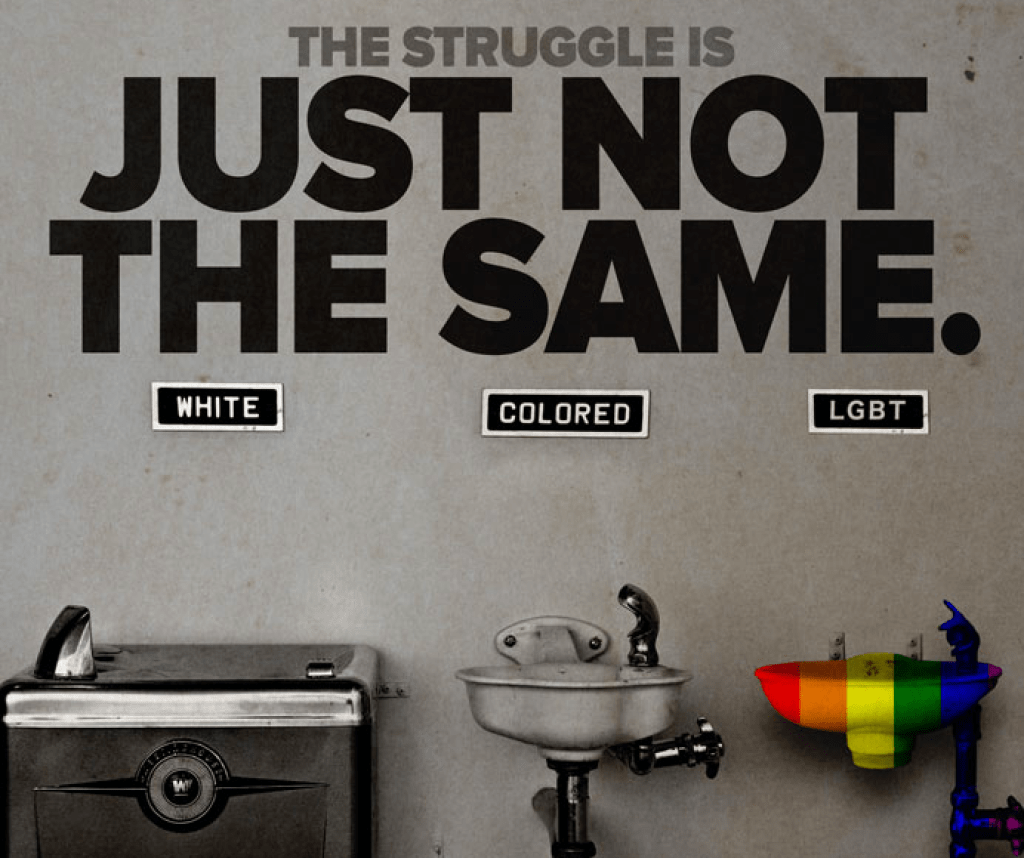
The most common analogy pressed into service of the fairness ordinance is the civil rights movement of the 1960s. In the minds of many, to be against the fairness ordinance is the same as being against civil rights for African Americans. Nothing could be further from the truth! In fact, to compare the two is potentially a slap in the face to those black Americans who genuinely suffered discrimination of the most horrible kinds.
Here are three reasons why gay is not the new black.
#1 – The injustices are not the same
Fairness ordinance proponents claim that the LGTBQ community suffers discrimination just like black American and they deserve to have the same class protection. But is this really the case or is the pro-LGTBQ community just co-opting experiences that are not theirs? Were they ever enslaved? Have they ever had their families ripped apart and sold on the auction block? Were they ever denied citizenship? Were they counted as 3/5 of a citizen? Have they been regularly attacked, beaten, or killed by groups like the KKK? Have they been denied the right to vote? When comparing LGTBQ discrimination to that of black Americans of the past two hundred years, it seems offensive to claim we are combatting the same problem.
#2 – Actions are different than inherent qualities
Those opposed to fairness ordinances are worried they will be forced to provide services that would make them complicit in tacitly approving sexual behavior they find morally objectionable. Being black is not a behavior; it is an inherent quality. However, homosexual behavior is an action. To discriminate against actions is in a whole different category than discriminating against inherent qualities of a person. We can grant that someone may be inherently same-sex attracted, but this is different than same-sex behavior. Therefore, the comparison once again falls short in obvious ways.
#3 – Gay is subjective, race is objective
The final problem with comparing gay to black is that one is that homosexuality is undetectable apart from self-identification. Let me quote at length from Voddie Baucham: “Determining whether or not a person is black, Native American, or female usually involves no more than visual verification. However, should doubt remain, blood tests, genetics, or a quick trip up the family tree would suffice. Not so with homosexuality. There is no evidence that can confirm or deny a person’s claims regarding sexual orientation. Moreover, the homosexual community itself has made this identification even more complicated in an effort to distance itself from those whose same-sex behavior they find undesirable. The Jerry Sandusky case is a prime example. Sandusky is accused of molesting numerous young boys during and after his tenure at Penn State. However, try placing the label “homosexual” on his activities and the backlash will be swift and unequivocal. “Pedophiles are not homosexuals!” is the consistent refrain coming from the homosexual community, media, academia, and the psychological/medical establishment. Hence, it seems same-sex attraction alone isn’t enough to identify a person as a homosexual. And what about LUGS in college, or same-sex relationships in prison? Are these people homosexual? How about men who are extremely effeminate but prefer women, or those who once were practicing homosexuals but have since come out of the lifestyle?”
Identifying homosexual individuals (or other alternate lifestyles) is a completely subjective enterprise fraught with all sorts of difficulties and unknown boundaries. Once again, gay is not similar to black.
Conclusion
While fairness ordinances are worth a civil discussion, we must dispense with comparing it to the Civil Rights movement of the 1960s. The two are miles apart in many fundamental ways. Worse, I fear, is that by comparing gay with black, we make light of the real racism that has haunted our country. If laws are needed for sexually alternative lifestyles, let’s not accomplish this by piggybacking the tragedy and hard fought victories against racial injustice.
 Jordan D. Tong
Leave a comment